
How Often Should Heat Treaters Run Payroll
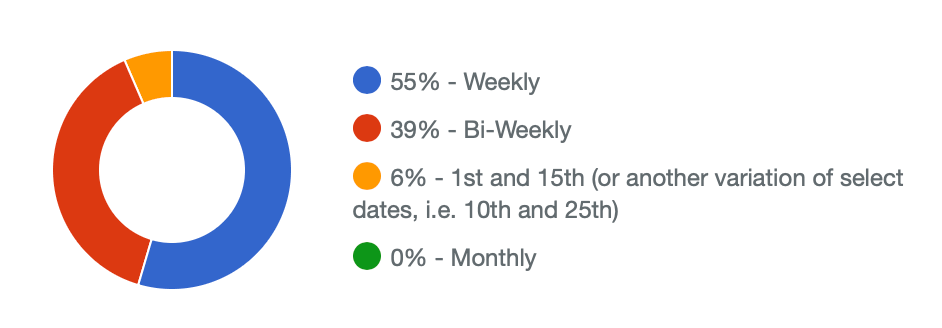
Weekly pay led a recent Metal Treating Institute Member survey, with 55% of respondents reporting that they pay employees every week. Another 39% pay every two weeks, 6% pay twice a month on set dates, and 0% reported paying monthly. Together, weekly and biweekly payroll accounted for 94% of responses.
For a heat treating plant, payday affects more than the accounting calendar. It determines how often employees see their earnings from extra shifts, how quickly supervisors must approve timecards, and when the business needs cash available for payroll. The survey offers a benchmark for MTI Members weighing those trade-offs.
Weekly pay
A weekly schedule typically means 52 paydays a year, often on the same weekday. When the pay period lines up with the plant’s workweek, employees can more easily match a paycheck to the shifts, premiums, and overtime they worked. The shorter gap between checks can also help employees manage recurring expenses.
The trade-off is a payroll deadline every week. Supervisors have less time to fix missed punches or confirm shift differentials before cutoff, particularly around holidays. Payroll staff have more runs to review and reconcile, and employers that pay a fee per run may spend more on processing.
Biweekly pay
Biweekly payroll typically means 26 paydays a year, on the same weekday every other week. A plant can keep two complete workweeks in each pay period if it aligns the calendars. Employees get a predictable payday, and the payroll team handles roughly half as many runs as it would on a weekly schedule.
Employees wait longer between checks, and finance needs to plan for months with three paydays. Those months can strain cash flow if the budget assumes two payroll withdrawals every month. The payroll team also needs to confirm how benefits deductions are handled on the third check.
Semimonthly pay
Semimonthly payroll means 24 paydays a year, commonly on the 1st and 15th or another pair of set dates. Two paydays each month make payroll funding and monthly benefits deductions easier to schedule. The fixed dates can also be convenient for employees who budget around monthly bills.
The number of workdays in each period varies, so hourly checks can fluctuate even when employees work a regular schedule. A pay-period cutoff can also split a workweek, requiring payroll to track hours across the cutoff to calculate overtime correctly. Paydays can fall on different weekdays, and weekends and holidays need to be accounted for in the calendar.
What to weigh before changing paydays
Start with the payday rules in every state where your employees work. Pay-frequency requirements can vary by state and employee category. Under federal law, covered nonexempt employees generally earn overtime for hours worked over 40 in a workweek. For example, a 46-hour week followed by a 34-hour week still includes six overtime hours under that rule, even when both weeks appear on the same check.
Hiring and the first paycheck. Compare pay schedules with nearby manufacturers competing for the same furnace operators and maintenance technicians. Look at the time from a new hire’s first shift to the first deposit. The pay frequency and the processing lag both affect that wait.
Shift coverage and payroll reliability. Test how each schedule handles overnight shifts, shift premiums, missed punches, and holiday bank cutoffs. Identify who can approve timecards or release payroll when the usual supervisor or payroll lead is out.
Total cost and cash flow. Compare vendor fees, staff time, and the cost of issuing corrections between regular runs. Map a full year of paydays against customer collections and large expenses such as utility bills. Check how deductions and PTO accruals would work on the new calendar.
One schedule or two. If permitted, consider whether hourly and salaried teams need different schedules. Weigh the benefit against running two calendars and handling transfers between pay groups.
Before switching, test a sample payroll and show employees their first two pay dates, the workdays each check covers, and what will happen to deductions. Flag any longer gap between deposits so employees have time to plan.